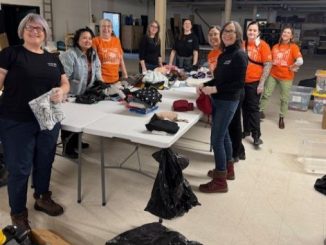
Women in Music Canada is helping reshape the sound and structure of the Canadian music industry. As a national non-profit dedicated to advancing gender equity, the organization supports and amplifies the voices of women and gender-diverse professionals across all areas of music. From mentorship and professional development to advocacy and community building, their work is rooted in creating a more inclusive and sustainable industry for future generations. We spoke with Robyn Stewart, Executive Director of Women in Music Canada, to learn more about her role, the organization’s impact, and the work still to be done.

Describe your charity/non-profit/volunteer work in a few sentences.
Women in Music Canada is a registered non-profit organization and one of the largest music industry associations in Canada, with over 2300 national members. Through programming, community building, and online resources, our goal is to strengthen the socio-economic balance of the music industry.
WIMC is dedicated to:
- Fostering gender equality in the music industry through the support and advancement of female-identifying and gender-diverse professionals and creatives at every stage of their career.
- Connect the community to learn and grow together through networking and mentorship events.
- Provide professional development, especially in under-represented areas of the music industry, through hosting educational, career development workshops, keynotes and intensive programs.
- Provide support, resources and advocacy for our community.
- Elevate, promote and celebrate women doing incredible work in music, artistry and industry.
What problem does it aim to solve?
WIM Canada aims to break down longstanding barriers to the advancement of women and gender diverse music creators and the industry. Unfortunately, we still see massively inequitable radio programming, executive leadership teams, live music programming, and so much more. We continue to receive disclosures from members who experience gender based harassment and discrimination in their work. We see caregivers leaving the industry because it is not at key points of their careers to manage both. We are here to support the needs of our membership and the ecosystem they work in. We work with the industry as a whole to reduce and ideally eliminate these circumstances.
When did you start/join it?
WIM Canada started in 2014, however I came on into the team in 2022.
What made you want to get involved?
Everything I loved most in my last role (ED of Western Canadian Music Alliance) was the projects we were working on focused on equity, diversity and inclusion. Yet I still saw so much work to be done. This role allowed me to be constantly inspired by the community we serve.
What was the situation like when you started?
When I started, we were looking at a nearly post-COVID industry that had stepped way back with respect to DEI programs. For necessity had put aside this work to just survive. We had, through COVID, seen women, caregivers, trans, non-binary and 2-Spirit individuals and those of intersectional experience, hardest hit by the pandemic. Many had left the industry altogether. It was a prime time to make sure that rebuilding was being done to take the industry to where it should be, more than where it had been in the past.
How has it changed since?
While many live spaces still suffer from essentially “long COVID,” seeing a slow build back to healthy live audiences, we are seeing some good that has come, which supports the work of WIM Canada. I noticed, through the heavy zoom timeframe that we were seeing, that each person has more to their life than themselves. Flexible work hours, remote work, and the importance of human-centred leadership are important, especially for caregivers. Mental health and wellness have never been more important and will continue to be. We found post-pandemic that the biggest thing members wanted was to connect with their community, to find new mentors and inspiration, and we have programmed accordingly to meet these needs.
What more needs to be done?
With a focus on the live sector, it will never be enough to leave equity to the festivals that are exclusively programming women and gender diverse artists. We need to see equitable, inclusive music programming (on stage and backstage in production roles), including safe spaces that consider the needs of everyone coming into their live spaces.
Additionally, we need to see more equity and diversity in leadership roles in music companies. This is what will support longstanding, sustainable change.
How can our readers help?
The best way for the wider community to help is to become a member or sign up for our newsletter to stay informed. And above all, to support equitable, inclusive and safe music programming. Demand to hear more representative voices on the radio. Expect and ask for resources and accommodations to make engaging with music safer for you and those around you.
Do you have any events coming up?
We will host a WIM Canada Brunch at The JUNOS on March 29, 2026. And a program we support, I encourage all to check out Honey Jam, August 29, 2026, at Massey Hall. This is a brilliant example of the work that is being done to support the growth of women’s careers in music.
Where can we follow you?
PAY IT FORWARD: What is an awesome local charity that you love?
I love Polaris Music Prize. They have been around a long time, supporting the pure artistic merit of new music, and less known that they are a charity.