
Set at the precise meeting point of two rivers that shaped the geography, trade, and identity of an entire region, The Forks stands as Winnipeg’s most layered and meaningful destination. It is at once ancient and modern, ceremonial and commercial, local and international. What makes it exceptional is not just what you can see or do there today, but the depth of history beneath your feet and the way that history continues to inform the experience of visiting it.
A Gathering Place for Over 6,000 Years
Long before the city of Winnipeg existed, The Forks was already one of the most important meeting places in what is now Canada. Its significance begins with geography: the confluence of the Red River and the Assiniboine River created a natural crossroads used by Indigenous peoples for thousands of years.
Archaeological findings in the area reveal evidence of human activity dating back more than 6,000 years. This was not a temporary or incidental site. It functioned as a seasonal gathering place where different Indigenous nations came together to trade goods, exchange knowledge, conduct ceremonies, and maintain relationships. Bison hunters camped here. Trade networks extended outward from this exact point, linking communities across vast distances.
The name “The Forks” itself reflects this geography, but the Indigenous name—often referenced as “Nestaweya,” meaning “three points”—captures a deeper understanding of the land as a meeting place not just of rivers, but of peoples.
With the arrival of Europeans, the importance of the site only intensified. During the fur trade era, The Forks became a critical node in the networks of the Hudson’s Bay Company and the North West Company. Traders, voyageurs, and Indigenous intermediaries all passed through this location, making it one of the busiest and most strategically important sites in the interior of the continent.
By the 19th century, as Canada expanded westward, The Forks transitioned again—this time into a transportation and industrial hub. Rail lines were built, warehouses constructed, and the site became central to the movement of goods and people into Western Canada. Immigration routes passed through here. Agricultural products moved east. Manufactured goods moved west.
But by the mid-20th century, this industrial activity declined. Rail use diminished, and the area fell into disuse, becoming a largely abandoned railyard. What followed is one of the most successful urban redevelopment stories in Canada. In the late 1980s, multiple levels of government and community stakeholders came together to reimagine the site—not as a commercial development, but as a public gathering space. The result is what exists today: a place that consciously integrates its past into its present.
Physical Location and Urban Context
The Forks sits at the heart of downtown Winnipeg, precisely where the Red and Assiniboine Rivers meet. This location is not incidental—it is the reason the city exists where it does.
Historically, river systems were the highways of the continent. Before railways and roads, the Red River provided a north-south route connecting the interior to Hudson Bay, while the Assiniboine River extended westward into the plains. The intersection of these routes made The Forks an inevitable centre of movement and exchange.
Today, that same centrality makes it one of the most accessible areas in the city. It connects easily to surrounding neighbourhoods, government buildings, and cultural institutions. Walking paths, bridges, and transit routes all converge here, reinforcing its identity as a literal and symbolic crossroads.
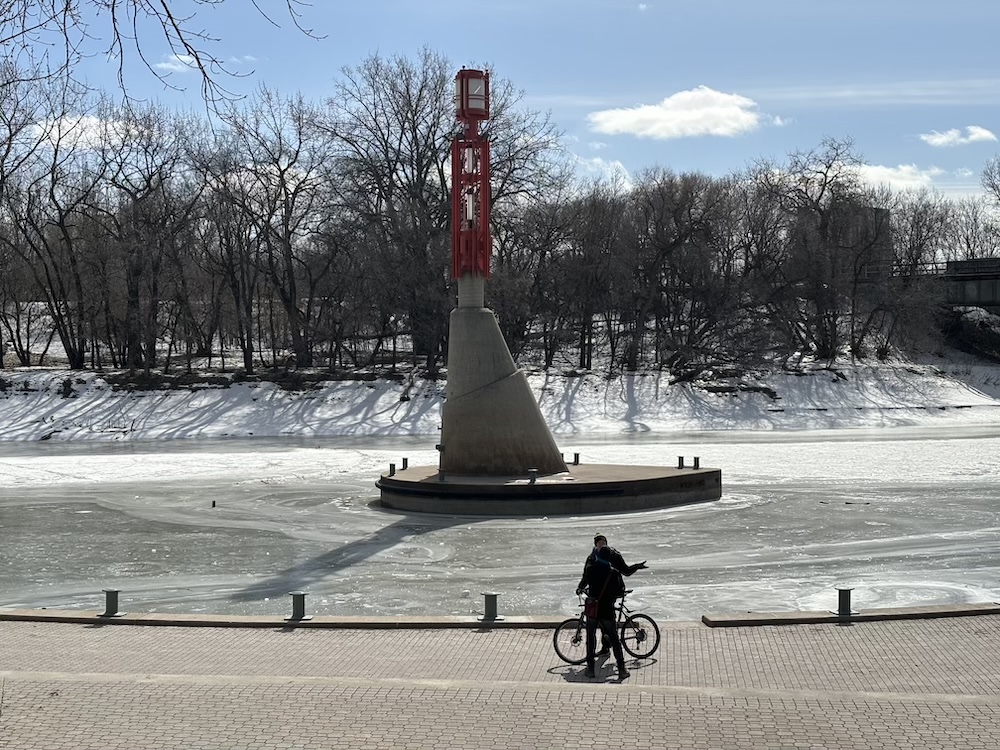
The landscape itself is carefully designed to highlight this geography. Open sightlines allow visitors to see the rivers meet. Boardwalks and pathways follow the water’s edge. Seasonal changes—frozen rivers in winter, flowing currents in summer—are not hidden but emphasized, making the natural environment a central part of the experience.
Major Attractions and Cultural Landmarks
One of the defining features of The Forks is how seamlessly it blends historical interpretation with modern cultural attractions.
Dominating the skyline nearby is the Canadian Museum for Human Rights, an architectural landmark that has become one of the most recognizable buildings in Canada. Its design—glass, stone, and dramatic vertical lines—reflects themes of transparency, struggle, and aspiration. Inside, exhibits explore human rights issues both globally and within Canada, making it not just a museum but a place of reflection and dialogue.
Within The Forks itself, the Oodena Celebration Circle offers a quieter, more contemplative experience. This circular, open-air space is aligned with the cardinal directions and rooted in Indigenous traditions. It functions as both a gathering space and a symbolic acknowledgement of the land’s original and ongoing cultural significance.
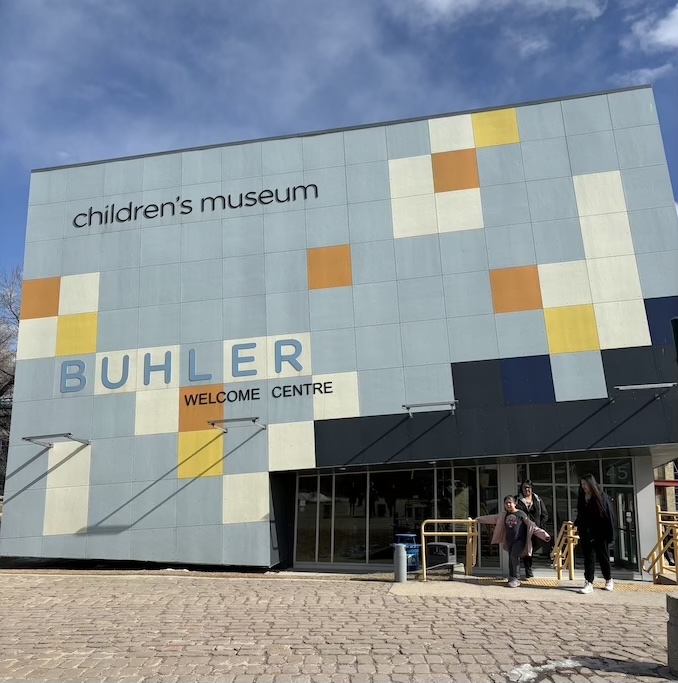
Families often gravitate toward the Manitoba Children’s Museum, housed in a historic train repair facility. Its exhibits are interactive and hands-on, reflecting the site’s ongoing role as a place of learning and engagement.
Nearby, The Forks National Historic Site preserves and interprets key elements of the area’s past, including archaeological remains and historical structures. Interpretive panels, guided tours, and installations help visitors understand the layers of history beneath the modern surface.
Public art is woven throughout the site. Sculptures, installations, and seasonal exhibits appear in plazas, along pathways, and near the water, reinforcing the idea that The Forks is not static but constantly evolving.
The Forks Market and the Evolution of Food Culture
At the centre of modern activity is The Forks Market, a building that reflects the site’s transition from industrial infrastructure to cultural destination.
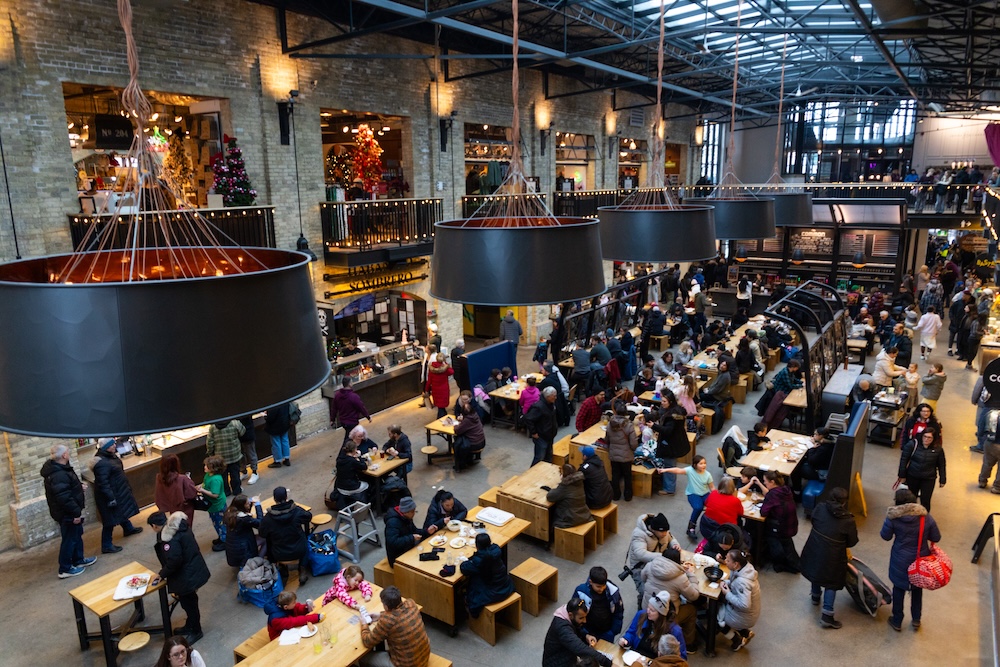
Originally constructed as a horse stable and later used for railway purposes, the building has been transformed into a vibrant public market. Inside, the atmosphere is intentionally communal. Long tables, open seating, and a mix of vendors encourage people to gather, share space, and experience a range of foods in a single visit.
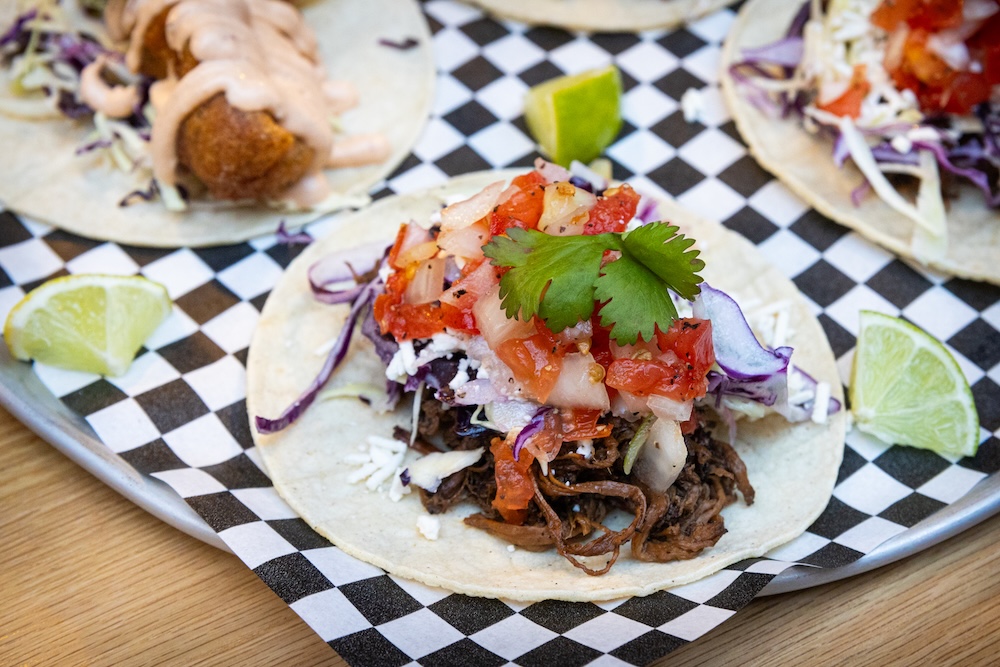
The food hall showcases Winnipeg’s diversity. Local vendors offer everything from classic prairie comfort foods to global cuisines influenced by the city’s immigrant communities. The emphasis is on independent businesses rather than chains, which gives the market a distinct identity and keeps it closely tied to the local economy.
Food here is not just about eating—it is about representing the city. Indigenous-inspired dishes, European influences, and contemporary culinary trends all coexist, reflecting Winnipeg’s layered cultural makeup.
Seasonally, offerings change, and new vendors rotate in, ensuring that even repeat visits feel different.
Shopping and the Johnston Terminal
Retail at The Forks is anchored by Johnston Terminal, a former cold storage warehouse that has been repurposed into a multi-level retail space.
Unlike typical shopping centres, the focus here is on local and regional products. Boutiques sell handmade goods, Canadian-designed clothing, specialty foods, and unique gifts that reflect the character of Manitoba and the Prairies.
This emphasis on local retail aligns with the broader philosophy of The Forks: it is not meant to replicate generic commercial spaces, but to provide something specific to Winnipeg. Visitors are not just buying products; they are engaging with the local culture and supporting small businesses.
Upper levels of the terminal also house additional vendors, offices, and viewing areas, offering different perspectives on the site and the surrounding rivers.
Outdoor Spaces and Seasonal Transformation
One of the most distinctive aspects of The Forks is how dramatically it changes with the seasons.
Summer and Warmer Months
In warmer weather, the site becomes a hub of outdoor activity. Riverwalks and trails are filled with pedestrians and cyclists. Patios open up, and public spaces host concerts, markets, and festivals.
Visitors can rent canoes or kayaks and explore the rivers directly, gaining a perspective that connects them more closely to the geography that defines the site. Gardens and green spaces provide places to relax, while shaded seating areas encourage longer stays.
Guided tours—both historical and cultural—offer deeper insight into the significance of the location, often incorporating Indigenous perspectives and storytelling.
Winter and the Nestaweya River Trail
In winter, The Forks undergoes a transformation that is uniquely Canadian. The rivers freeze, and the Nestaweya River Trail emerges.
This skating trail, which can stretch for several kilometres depending on ice conditions, is one of the longest natural skating trails in the world. It connects multiple parts of the city and turns the rivers into active public space.
Warming huts—many designed by architects and artists—are placed along the trail, adding both functionality and artistic expression. Skaters, walkers, and visitors move along the ice, creating a dynamic winter landscape that contrasts sharply with the summer experience.
Snow sculptures, winter festivals, and seasonal programming ensure that The Forks remains active year-round rather than becoming dormant in colder months.
Events, Festivals, and Community Life
The Forks is not just a place to visit—it is a place where events happen continuously.
Throughout the year, it hosts cultural festivals, live music, food events, and public celebrations. These range from large-scale gatherings to smaller, community-focused activities.
Because of its central location and open design, it functions as a natural venue for public life in Winnipeg. People come not just for specific attractions, but to spend time, meet others, and participate in shared experiences.
This ongoing programming reinforces the original purpose of the site as a gathering place. While the context has changed, the function remains remarkably consistent across centuries.
What to Do: A Complete Visitor Experience
A visit to The Forks can be structured or spontaneous, short or extended.
A typical visit might begin with a walk along the river to understand the geography, followed by time in the market exploring food options. From there, visitors might browse shops in the Johnston Terminal, visit nearby museums, or attend an event.
For those interested in history, guided tours and interpretive exhibits provide context that transforms the experience from casual sightseeing into something more meaningful.
For families, the combination of open space, interactive attractions, and food options makes it an easy and flexible destination.
For visitors looking to immerse themselves, spending several hours—or even returning multiple times across different seasons—reveals how much the site changes and how much there is to explore.
Why The Forks Defines Winnipeg
What makes The Forks exceptional is not any single feature, but the way everything comes together.
It is rare for a place to maintain such a clear connection between its ancient origins and its modern function. At The Forks, that continuity is visible and intentional. The same reasons people gathered here thousands of years ago—access, connection, exchange—are still the reasons people come today.
It is a place where history is not confined to museums, where food reflects identity, where public space is actively used, and where the city presents itself in its most authentic form.
For anyone visiting Winnipeg, The Forks is not just a stop on the itinerary. It is the foundation of the city’s story—and the best place to begin understanding it.
![Councillors of the Provisional Government of the Métis Nation. Front row, L-R: Robert O'Lone, Paul Proulx. Centre row, L-R: Pierre Poitras, John Bruce, Louis Riel, John O'Donoghue, François Dauphinais. Back row, L-R: Bonnet Tromage, Pierre de Lorme, Thomas Bunn, Xavier Page, Baptiste Beauchemin, Baptiste Tournond, Joseph (Thomas?) Spence[1] This image is frequently listed with the caption that the persons in the photograph are councillors of the Provisional Government of the Métis Nation, however, there are several persons in the image who were not councillors in the Legislative Assembly, but did hold offices at different levels of the provisional government.](https://winnipegguardian.com/wp-content/uploads/2026/04/ProvisionalMetisGovernment-326x245.jpg)